
Spokesperson Guide: Role, Criteria, and Crisis Communication
The spokesperson role, how it differs from PR, six criteria for choosing one, interview preparation, crisis guidance, and the most common mistakes.
A spokesperson is the person officially appointed to communicate an organization's position and information to the media and the public. A good spokesperson knows the facts, has the authority to answer, is easy to reach, and stays calm on camera, especially during a crisis. One prepared spokesperson is far more useful than many officials speaking without coordination.
This article covers the spokesperson's role, how to choose one, how the role differs from PR, preparation before interviews, guidance during a crisis, and the most common mistakes. It applies to government institutions, state-owned enterprises, and companies.
The spokesperson's role
- Communicating the official position with one voice, so the public does not receive conflicting information.
- Answering media questions quickly and accurately, including requests for comment.
- Explaining the context behind a policy or event in language people understand.
- Being the organization's face in a crisis, showing empathy and the steps being taken.
Spokesperson vs PR team
|
Aspect |
PR team |
Spokesperson |
|---|---|---|
|
Main role |
Plans and manages communication |
Delivers messages to the media and the public |
|
Work |
Writes press releases, monitors media, prepares materials |
Interviews, press conferences, official statements |
|
Who |
A team or unit |
One or a few appointed people |
In many organizations the head of PR is also the spokesperson. That works, as long as they have access to leadership and the authority to answer.
How to choose a spokesperson
- Authorized: can answer without always waiting for permission. A spokesperson whose every answer is "we will coordinate first" loses journalists' trust.
- Knows the substance: understands the data, regulations, and programs, not just the script.
- Communicative: explains technical matters with short sentences and easy examples.
- Calm under pressure: not defensive when facing sharp questions.
- Easy to reach: journalists work to deadlines. An unreachable spokesperson means stories run without the organization's side.
- Credible to the public: on technical issues, internal experts are often trusted more than senior officials.
Large organizations should have more than one: one spokesperson for the organization's general position, and one or two technical sources for specific issues. Their roles must be clear so they do not get ahead of each other.
Preparing for an interview
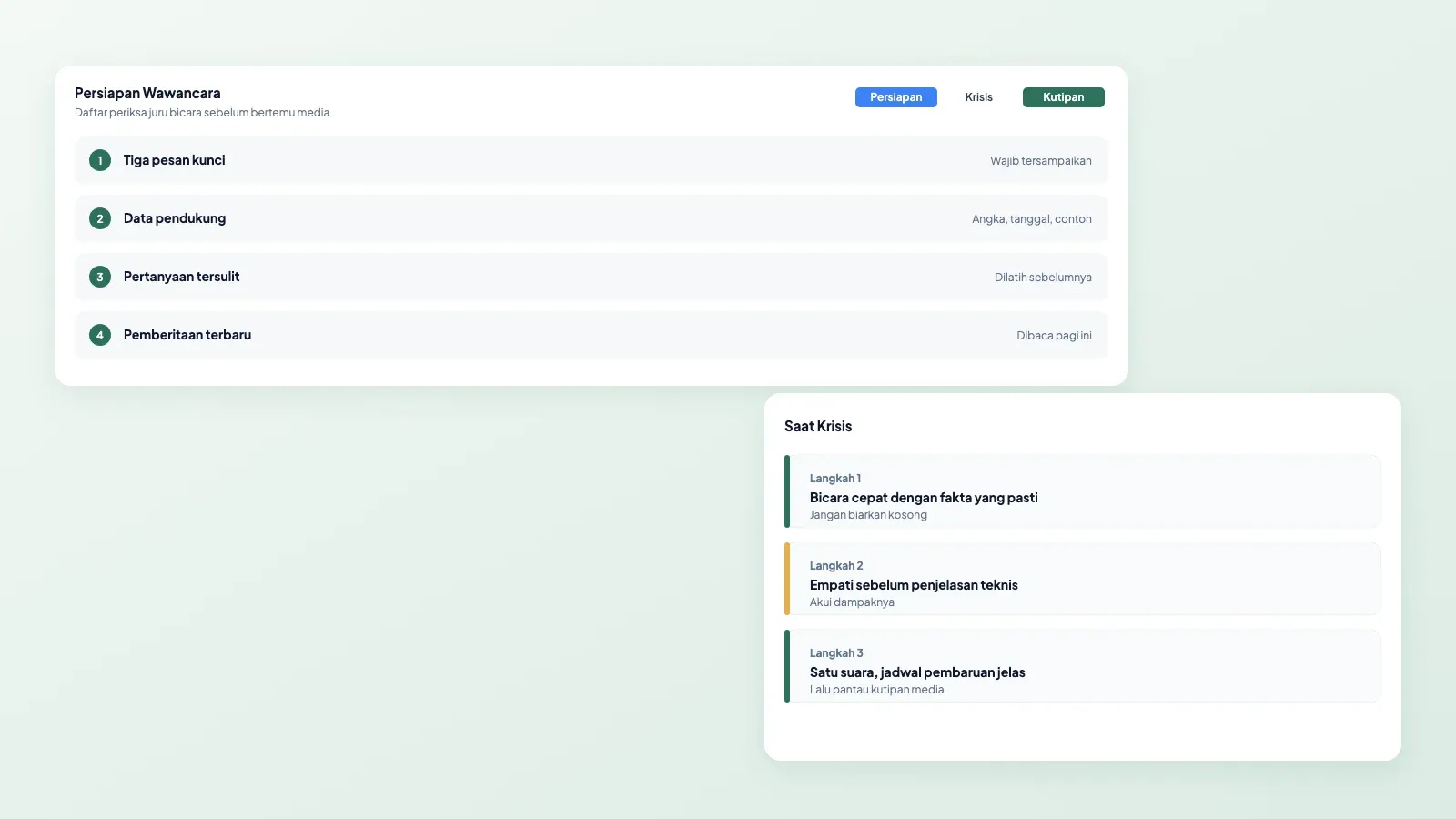
- Set three key messages that must come across whatever the questions are.
- Prepare supporting data: numbers, dates, and examples that can be quoted.
- Rehearse answers to the hardest questions, especially the ones you most want to avoid.
- Check the latest coverage: what has been written, who was quoted, and what the tone is. This is usually in the daily media monitoring report.
- Know the outlet: print, online, radio, and television need different lengths and quote formats.
Spokesperson guidance during a crisis
1. Speak early, even before all facts are in
Silence leaves room for speculation. Share what is known, what is being done, and when the next update will come. An initial statement like this is called a holding statement.
2. Show empathy before technical explanations
If people were hurt or harmed, start by acknowledging the impact. Technical explanations without empathy easily read as evasive.
3. Do not speculate
If you do not know yet, say so and say when you will. A cause or number that later proves wrong becomes a second, worse story.
4. One voice
Make sure other officials do not make different statements. Route all interview requests to the appointed spokesperson.
5. Update on a regular schedule
Set an update schedule, for example every morning and afternoon, and keep to it. Journalists are calmer when they know when the next information is coming.
6. Monitor what gets published
After a statement, check how the media quote it. Correct mistakes quickly. Crisis signals and escalation are covered in crisis communication early warning.
Common spokesperson mistakes
- Saying "no comment". To the public it often sounds like admitting fault. Better: "We are checking and will share the results at 16:00."
- Blaming others on camera. Even if it is correct about who is responsible, a defensive delivery can become its own story.
- Using technical terms without explanation. Quotes that are hard to understand are rarely used, or used wrongly.
- Going off the record without a clear agreement. Indonesia's Journalistic Code of Ethics asks journalists to respect off-the-record terms as agreed, so the agreement must be stated at the start, not after the information is shared.
- Contradicting official data. Make sure the numbers match the press release and the official website.
Supporting the spokesperson with media monitoring
Spokespeople do better when they know what the media are saying before an interview starts. Qola monitors national and regional online news, labels sentiment in the context of Bahasa Indonesia, flags spikes early, and prepares reports that can be read in minutes. See solutions for government PR or contact us.
FAQ: spokespeople
What does a spokesperson do?
Communicates the organization's official position and information to the media and public, answers questions and requests for comment, explains context, and is the organization's face during a crisis.
What is the difference between a spokesperson and PR?
PR plans and manages the organization's communication. The spokesperson delivers messages to the media and public. The head of PR can also be the spokesperson.
What makes a good spokesperson?
Authority to answer, knowledge of the substance, clear communication, calm under pressure, availability, and public credibility.
What should a spokesperson do in a crisis?
Speak early with confirmed information, show empathy, avoid speculation, keep one voice, update regularly, and monitor how statements are quoted.
Can a spokesperson say "no comment"?
It is best avoided. Explain that the information is being checked and say when it will be shared.