
How to Measure Press Release Reach: 6 Metrics with Real Data
Measure press release reach with six metrics: outlets, uniform or rewritten headlines, target outlets, key message, coverage lifespan, and tone, using data from five real releases.
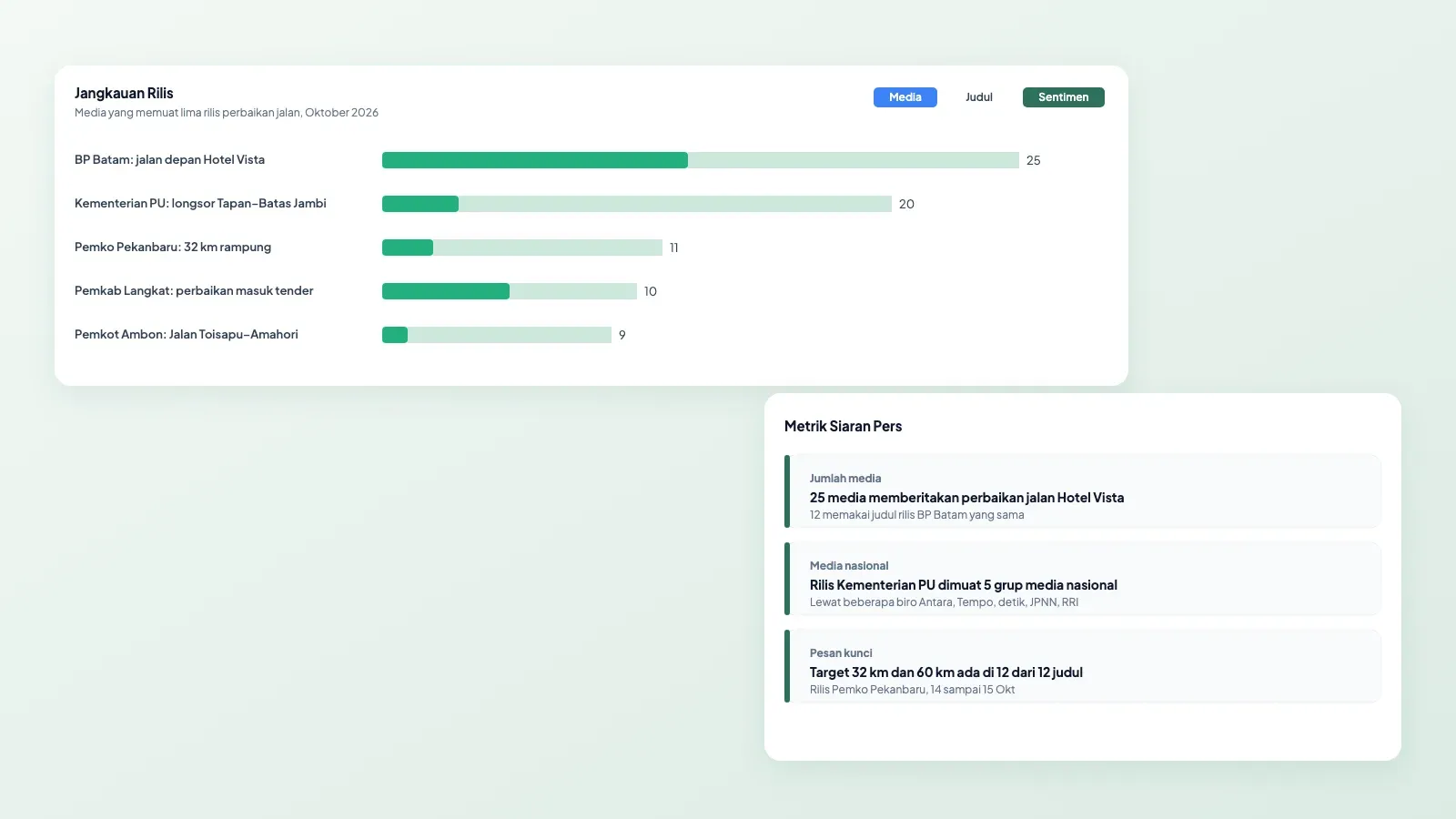
Press release reach is measured by how many different outlets carried it, not by the number of articles. Complete it with five more metrics: how many used a uniform headline or rewrote it, whether target outlets carried it, whether the key message made it into headlines, how long coverage lasted, and what the tone was. Two releases with the same number of articles can have very different results, and these six metrics show the difference.
This guide uses real data: five road repair announcements from Indonesian government bodies that circulated in online media in October 2026, part of the 2,254 articles in the October 2026 road damage news report. How to write a press release is covered in the press release guide. This article covers the next step: measuring the result.
Summary of the five releases measured
|
Announcement |
Articles |
Outlets |
Most common uniform headline |
National media groups |
Days with coverage |
|---|---|---|---|---|---|
|
Batam authority: road repair in front of Hotel Vista |
27 |
25 |
12 outlets |
0 |
8 days |
|
Ministry of Public Works: Tapan–Jambi border landslides |
26 |
20 |
3 outlets |
5 |
5 days |
|
Pekanbaru city: 32 km of roads repaired, 60 km target |
12 |
11 |
2 outlets |
2 |
2 days |
|
Langkat district: road repair goes to tender |
10 |
10 |
5 outlets |
0 |
5 days |
|
Ambon city: maintenance of the Toisapu–Amahori road |
10 |
9 |
1 outlet |
1 |
2 days |
A uniform headline counts outlets whose headline is the same or nearly the same (identical first six words). National media are counted per media group, so several regional bureaus of one news agency count once. "Days with coverage" is the number of days with at least one article.
Metric 1: Outlets that carried it, not articles
One outlet can publish several articles from the same release, such as a first story and then updates. The article count is therefore always larger than the real reach. Count distinct outlets.
The Batam authority's announcement about repairing the road in front of Hotel Vista appeared in 27 articles, but from 25 outlets. The Ministry of Public Works release about the Tapan–Jambi border landslides appeared in 26 articles from 20 outlets. The gap is small here, but it can be large for issues updated every day.

Metric 2: Uniform or rewritten headlines
Compare headlines across outlets. Headlines that are the same or nearly the same, for example with identical first six words, usually mean outlets published the release as is. Different headlines mean the newsroom worked on it: choosing an angle, adding data, or interviewing other sources.
- Many uniform headlines: 12 of the 25 outlets covering the Hotel Vista road repair used a headline starting with "BP Batam Kebut Perbaikan Jalan Depan Hotel Vista" (Batam authority speeds up road repair in front of Hotel Vista), differing only at the end. In Langkat, 5 of 10 outlets used the same headline announcing that the repair had entered the tender stage.
- Almost all rewritten: the Pekanbaru city release was carried by 11 outlets with 12 different headlines. The Ministry of Public Works release was carried by 20 outlets, and its most common headline appeared in only 3.
Neither is automatically better. Uniform headlines show a release that was ready to publish and reached many small outlets. Rewritten headlines show newsrooms considered the content worth covering themselves, which readers usually trust more.
Metric 3: Whether target outlets carried it
Define target outlets before sending the release, then check whether they carried it. The Ministry of Public Works release on the Tapan–Jambi border landslides was carried by five national media groups: several Antara bureaus, Tempo, detik, JPNN, and RRI, in addition to the ministry's own website. The Pekanbaru city release reached Kompas TV and Tempo.
By contrast, the Batam authority's announcement was not carried by any national outlet. That is not a failure. Repairs to one city road matter most to Batam residents, and the 25 outlets that carried it were Riau Islands media. Reach is judged by fit with the target audience, not by how big the outlet's name is.
Metric 4: Whether the key message reached the headline
Many readers only read headlines. Check how many headlines carried the release's main message, such as a number, a target, or a stage.
|
Release |
Key message |
In the headline |
|---|---|---|
|
Pekanbaru city |
32 km finished, 60 km target |
12 of 12 articles |
|
Langkat district |
Repair has entered the tender stage |
10 of 10 articles |
|
Ministry of Public Works |
Number of landslide points handled |
13 of 26 articles |
|
Batam authority |
Duration, repair depth, or completion target |
11 of 27 articles |
|
Ambon city |
Budget of IDR 982 million |
4 of 10 articles |
Simple, concrete numbers, such as "32 km finished, 60 km target", travel best. Releases with many numbers at once tend to lose some of them in headlines.
Metric 5: How long coverage lasted
Count articles per day from the day the first one appeared. The pattern shows whether a release was covered for one day or kept going.

- One-day burst: 10 of 12 Pekanbaru articles appeared on the first day. Ambon was similar, with 7 of 10 on the first day.
- A full week: coverage of the Hotel Vista road repair appeared on 8 different days, from the road closure announcement on 15 October through work updates, peaking at 14 articles on 20 October. Information released in stages gives outlets a reason to write again.
- For comparison, not a release: a North Sumatra provincial legislator's call to repair a damaged road was carried by 11 outlets in one day, 9 of them negative, and then stopped. This one-day pattern is common for statements, whether from government bodies or their critics.
Metric 6: Tone of coverage
A release carried widely but framed negatively can do more harm than one not carried at all. Check the sentiment of every article that carried the release. For the five announcements above, the tone was almost entirely positive or neutral. For example, 22 of 27 Hotel Vista articles were positive and none were negative. Compare that with the North Sumatra legislator's statement above, where 9 of 11 articles were negative.
Also watch for articles that cite your release but add criticism, such as residents questioning the target. Automatic sentiment labels help filter, but articles like these should be read directly.
Example press release scorecard
Use this simple format for each release. Fill it from the list of collected articles, for example from your media clipping.
|
Column |
How to fill it |
Example (Pekanbaru city) |
|---|---|---|
|
Outlets that carried it |
Count distinct outlet domains |
11 |
|
Most common uniform headline |
Number of outlets with the same or nearly the same headline |
2 |
|
Target outlets that carried it |
Match against the target list |
Kompas TV, Tempo, Riau outlets |
|
Key message in headline |
Count headlines carrying the main message |
12 of 12 |
|
Coverage lifespan |
First to last day with an article |
2 days, 83% on the first day |
|
Tone |
Positive, neutral, negative |
7 positive, 3 neutral, 2 unlabeled |
Repeat this for each release, then compare month to month. To measure a campaign made of many releases, see PR campaign evaluation. To compare your share of coverage with other institutions or brands, see how to calculate share of voice.
Common mistakes when measuring press releases
- Reporting article count as reach. Updates and duplicates on the same outlet make the number look bigger.
- Treating uniform headlines as failure. For public service information that must reach many regional outlets, a release published as is may be exactly the goal.
- Measuring without a target list. Without targets, 25 regional outlets and 2 national ones cannot be compared.
- Stopping at day one. Some releases only peak days later, like Hotel Vista, which peaked five days after the first article.
- Ignoring articles that do not use the release's keywords. Outlets that rewrite often use different terms. Also search by location or program name.
Measuring press releases with Qola
In Qola, every national and regional online news article is recorded with its outlet, publication date, headline, and sentiment labeled in the context of Bahasa Indonesia. The metrics above can be calculated from one list of articles, then presented as Excel, PDF, or infographic reports. The daily trend also shows how long a release stays in the news.
See solutions for government PR, or contact us to measure the reach of your institution's press releases.
Data: Qola analysis of national and regional Indonesian online news for the keywords "kondisi jalan" (road condition) and "kerusakan jalan" (road damage), October 2026 (Western Indonesia Time), after filtering. Articles were grouped per announcement by headline keywords, so articles using very different terms may not be counted. Sentiment labeled automatically by Qola AI. You may cite this data with Qola (qola.id) as the source.
FAQ: measuring press release reach
How do you measure press release reach?
Count the distinct outlets that carried the release, then add five metrics: uniform or rewritten headlines, target outlets that carried it, the key message in headlines, how long coverage lasted, and the tone of coverage.
What is the difference between article count and outlet count?
Article count includes every article, including updates and duplicates on the same outlet. Outlet count counts distinct outlets. For example, the Hotel Vista road repair announcement in Batam appeared in 27 articles from 25 outlets.
Is a press release published with the same headline a bad sign?
Not always. Uniform headlines show a release that was ready to publish and reached many small outlets, which suits public service information. Rewritten headlines show newsrooms worked on the information themselves, which readers usually trust more.
How long is a press release usually covered?
Most releases are covered for one or two days. In the October 2026 data, 10 of 12 articles from the Pekanbaru city release appeared on the first day. Information released in stages, like the Hotel Vista road repair in Batam, can last up to 8 days.
What should a press release results report include?
Outlets that carried it, the number of uniform headlines, target outlets that carried it, the key message in headlines, coverage lifespan, and tone. Compare from release to release and from month to month.