
Road Damage News in Indonesia, October 2026: Data from 2,254 Articles
Qola data from 2,254 online articles: daily trend, top provinces, themes, sentiment, three stories that drove road damage coverage, and who must repair damaged roads.
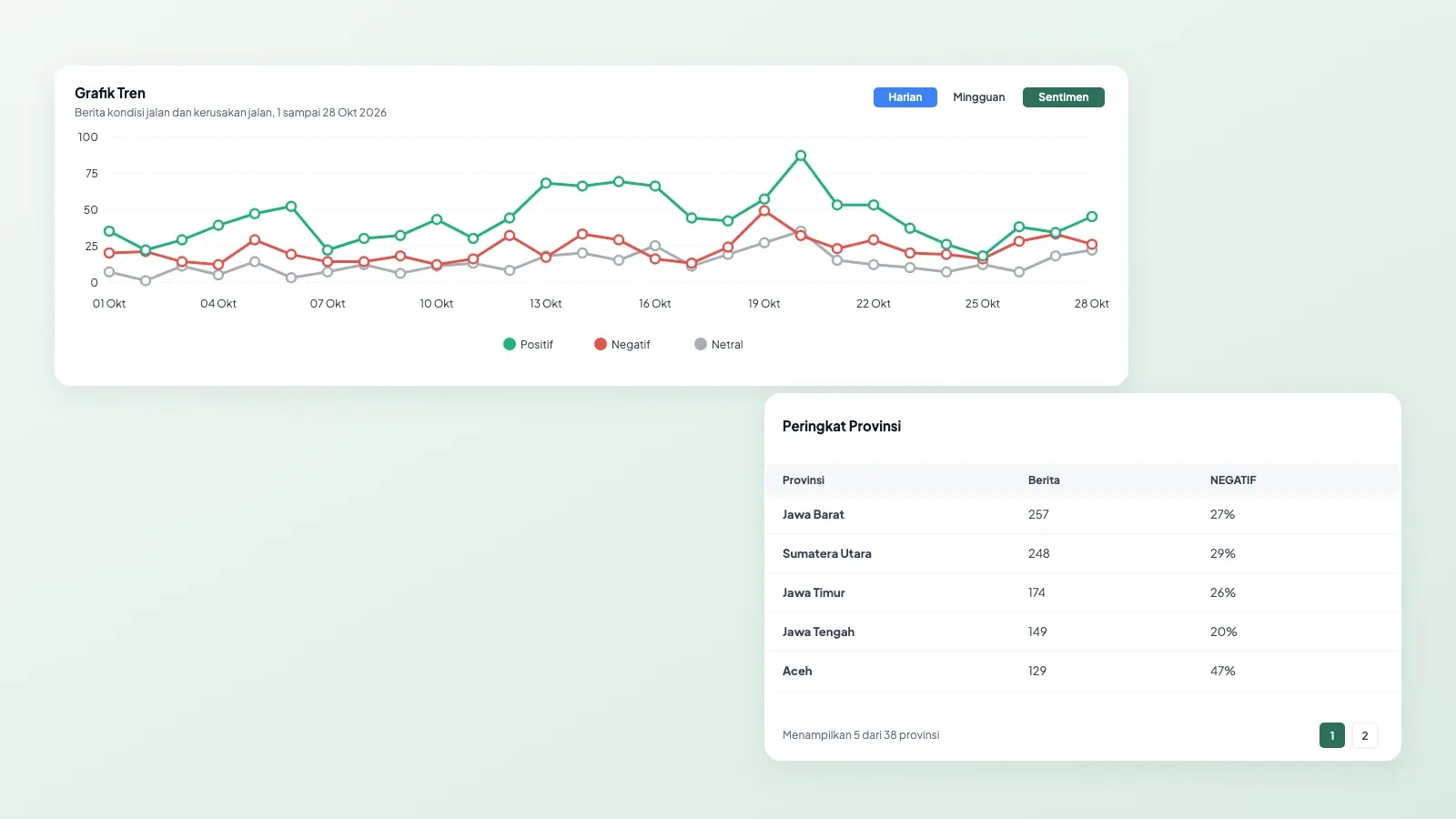
From 1 to 28 October 2026, Qola recorded 2,254 online news articles about damaged roads and road repairs in Indonesia, from 1,013 outlets. Of these, 55% were positive, 17% neutral, and 28% negative. The large positive share comes from regional governments announcing repairs. Negative coverage was smaller but spread fastest: viral complaints from residents, landslides cutting off roads, and accidents on potholed roads.
This is the first edition of Qola's monthly report on public issues by sector. It covers the daily trend, the provincial breakdown, the most common themes, three stories that drove coverage, who is legally responsible for repairing damaged roads, and methodology notes. The previous edition covered toll road news.
October 2026 at a glance
|
Metric |
Value |
Note |
|---|---|---|
|
Relevant articles |
2,254 |
After filtering 10,305 raw articles |
|
Outlets |
1,013 |
National and regional online media |
|
Positive sentiment |
1,228 (55%) |
Repairs started or finished, budgets allocated |
|
Neutral sentiment |
371 (17%) |
Announcements, traffic management, explanations |
|
Negative sentiment |
628 (28%) |
Resident complaints, cut-off roads, accidents |
|
Busiest day |
20 October (156 articles) |
Week three contributed 757 articles |
|
Top province |
West Java (257) |
Followed by North Sumatra (248) and East Java (174) |
Sentiment shares are calculated from the 2,227 labelled articles. 27 articles had no label yet.
Daily trend: coverage peaked in week three

Volume rose steadily through the month and peaked in the third week. On 19 and 20 October several large stories overlapped: a road damage dispute in Ciamis, an expert explanation of why asphalt fails early, and a national road in North Sumatra cut off by a landslide.
|
Week |
Dates |
Articles |
Daily average |
|---|---|---|---|
|
1 |
1 to 7 October |
424 |
61 |
|
2 |
8 to 14 October |
555 |
79 |
|
3 |
15 to 21 October |
757 |
108 |
|
4 |
22 to 28 October |
518 |
74 |
Provinces with the most road damage coverage
1,858 articles (82%) could be mapped to a province from place names in the headline or locations recognised by AI. The top ten:

|
Province |
Articles |
Outlets |
Negative |
Positive |
|---|---|---|---|---|
|
West Java |
257 |
146 |
27% |
54% |
|
North Sumatra |
248 |
113 |
29% |
61% |
|
East Java |
174 |
118 |
26% |
56% |
|
Central Java |
149 |
77 |
20% |
62% |
|
Aceh |
129 |
68 |
47% |
41% |
|
West Sumatra |
95 |
60 |
26% |
62% |
|
Riau |
93 |
54 |
22% |
59% |
|
Banten |
77 |
46 |
40% |
40% |
|
East Kalimantan |
57 |
40 |
40% |
42% |
|
Bengkulu |
51 |
24 |
24% |
57% |
Article counts are not road damage counts. Provinces with many regional outlets tend to appear more often. The negative share is more telling. Aceh had the highest negative share (47%), driven mainly by floods and landslides cutting national and provincial roads in Gayo Lues and Southeast Aceh, and by complaints about a national road in Bireuen that was damaged again a month after repair. Banten and East Kalimantan were both at 40%.
Most common themes
Themes are counted from words in headlines. One article can fall under more than one theme.

|
Theme |
Articles |
Negative share |
|---|---|---|
|
Repairs started, ongoing, or finished |
914 |
18% |
|
Budgets and regional spending |
321 |
30% |
|
Floods and landslides |
274 |
36% |
|
Heavy vehicles, mining traffic, and overloading (ODOL) |
227 |
23% |
|
Resident complaints and protests |
131 |
64% |
|
Regional legislators and politicians |
122 |
31% |
|
Self-funded repairs or company support |
87 |
24% |
|
Accidents caused by damaged roads |
53 |
74% |
|
New roads failing early and project quality |
38 |
59% |
The pattern is clear. Regional governments actively announce repairs, and that coverage is mostly positive. Resident complaints, accidents, and new roads that fail early are small themes, but their negative share is close to or above 60%. One viral case in these small themes can outweigh dozens of repair announcements.
Three stories that drove coverage
1. Ciamis: who is responsible for a damaged road
On 16 October, a video of the West Java governor's convoy being steered by residents onto a damaged road in Cintajaya village, Lakbok, Ciamis spread widely. In the video the governor stressed that road responsibility is split between village, district, provincial, and national authorities, and that complaints about district roads should go to the district head. He later apologised, and repairs estimated at around Rp16 billion were proposed for the 2027 regional budget.
Qola recorded 31 articles from 23 outlets on this episode between 16 and 21 October: 12 negative, 11 neutral, and 7 positive. Residents who had complained about the road since 2012 received wide coverage. The lesson: the division of road responsibility, clear on paper, is often not understood by the public. A late explanation delivered in the heat of the moment becomes a new story.
2. Binjai and Langkat: viral, then repaired within days
In North Sumatra, a report of three trucks overturning in one week on Jalan Diponegoro, Binjai, was published on 2 October. Three days later, media reported the road was being repaired, and local leaders inspected it the following day. Between 18 and 22 October, a single release from the Langkat regency government about road repairs in Binjai district entering the tender stage ran with almost identical headlines in 8 outlets.
Two lessons follow. A fast response after a complaint goes viral turns coverage from negative to positive. A clear, informative press release with stages, budget, and schedule is easy for regional media to republish. See how to write a press release.
3. Why asphalt fails early: not just heavy vehicles
On 20 October, an explanation by ITS road infrastructure expert Dr. Catur Arif Prastyanto on why asphalt roads deteriorate quickly was republished by at least 6 outlets. He named four causes: an unstable subgrade, water trapped by poor drainage, over-dimension and overloaded vehicles (ODOL), and the quality of materials and construction.
Explanations like this matter for public works communication teams. When the public asks why a newly repaired road is already damaged, an independent technical answer is often trusted more than an agency statement.
Who must repair a damaged road?
Indonesia's Law No. 22 of 2009 on Road Traffic and Transport, Article 24, requires road operators to promptly and properly repair damaged roads that may cause accidents. If repairs cannot be done yet, the operator must place signs at the damaged section. Article 273 of the same law sets criminal penalties for operators whose negligence leads to an accident.
The responsible operator depends on the road's status:
- National roads: the central government through the Ministry of Public Works.
- Provincial roads: the provincial government.
- District and city roads: the district or city government.
- Toll roads: toll road companies, under government regulation.
Residents often do not know a road's status, as the Ciamis case showed. Easily accessible status information, such as signs on site or an online map, can reduce misdirected complaints.
Methodology and limitations
- Data source: national and regional online news collected by Qola for the Indonesian keywords "kondisi jalan" (road condition) and "kerusakan jalan" (road damage), published 1 to 28 October 2026 (Western Indonesia Time).
- Filtering: from 10,305 raw articles, duplicate headlines on the same outlet were merged, and articles not about road damage or repair were removed, such as car reviews, foreign news, and street protests. The result is 2,254 articles. Filtering rules are based on words in headlines and summaries, so a small number of articles may be wrongly included or excluded.
- Sentiment: labelled automatically by Qola's AI in the context of Bahasa Indonesia. Automated labels should still be verified for important decisions.
- Provinces: mapped from province, district, or city names in headlines, then from AI-recognised locations. 18% of articles could not be mapped. Place names that are also everyday words were counted only with context, such as "Kabupaten Pati".
- Volume is not road condition. These figures describe media attention, not the actual length of damaged roads.
Lessons for regional government and public works PR teams
- Explain responsibility before you are asked. Publish each road's status and the responsible agency. Explanations that arrive after a viral video tend to read as deflection.
- Monitor by area, not just totals. Road issues are highly local. A spike in complaints in one district can disappear inside a provincial total. This approach is covered in issue management.
- Prepare for the rainy season. Floods and landslides accounted for 274 articles with a 36% negative share. Alternative routes, repair schedules, and emergency contacts should be ready before incidents happen.
- Announce repairs with data. Repair stories that name the road section, budget, and completion target were republished most often.
Qola tracks national and regional online news, labels sentiment in the context of Bahasa Indonesia, maps issues by region, and flags spikes early. See solutions for government PR, or contact us for a similar analysis of your region or sector.
Cover chart: Qola analysis of national and regional online news, 1 to 28 October 2026. Free to cite with credit to Qola (qola.id).
FAQ: road damage news in October 2026
How many news articles covered damaged roads in October 2026?
Qola recorded 2,254 online articles about road damage and repair from 1,013 outlets between 1 and 28 October 2026, after filtering 10,305 raw articles.
Which provinces had the most road damage coverage?
West Java (257 articles), North Sumatra (248), and East Java (174). The highest negative share was in Aceh (47%), mainly due to floods and landslides cutting off roads.
Why was most road damage coverage positive?
Because many articles reported repairs starting or finishing and budgets being allocated by regional governments. Negative articles were fewer but more likely to go viral.
Who is responsible for repairing damaged roads in Indonesia?
The road operator according to the road's status: the central government for national roads, the provincial government for provincial roads, and the district or city government for district and city roads. The repair obligation is set out in Article 24 of Law No. 22 of 2009.
Can Qola produce a similar analysis for my region or organisation?
Yes. Qola can monitor specific issues, regions, or sectors and present trends, sentiment, provincial breakdowns, and leadership-ready reports. Contact the Qola team through the contact page.